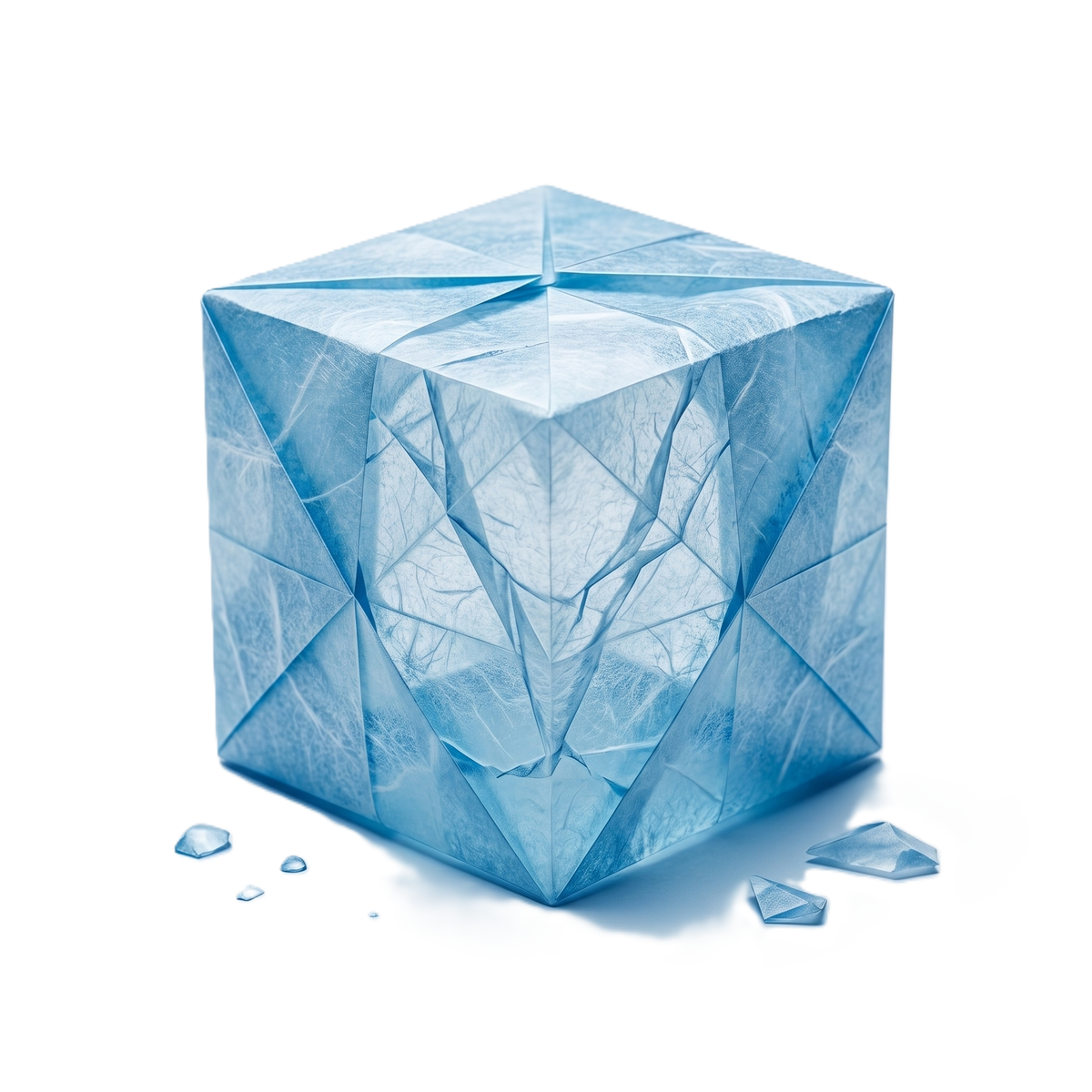
Ice on the Greenland ice sheet can be older than a hundred thousand years. Each summer a little of it breaks away, drifts west into Baffin Bay, and grounds in the shallows off Qikiqtarjuaq — a hamlet on Baffin Island that the charts still call iceberg alley. There it waits, and slowly gives its water back.
We use some of that water. In a handful of our formulas the line on the label that reads aqua is not municipal water softened and corrected. It is meltwater from ice that pressed itself solid before farming, before writing, before the wheel.
"We did not make this water. We only waited for it to arrive."

What the ice remembers
Glacial ice is not frozen lake water. It is snow — thousands of years of it — pressed under its own weight until the trapped air is squeezed into fine bubbles and the crystals grow clear and faintly blue. Because it never touched rock or soil on the way down, it carries almost nothing dissolved in it: a few parts per million where ordinary tap water carries several hundred. It is among the softest water on earth.
We buy ours by the season from a small partnership of families at Qikiqtarjuaq, who take only ice already calved and grounded, never cut from a living glacier. Nothing is hurried. A block the size of a kitchen table yields a few litres of the clear core once the weathered outer rind is set aside.
Why old water at all
The honest answer is that age is not, by itself, a cosmetic ingredient. A water molecule does not improve with keeping. What the long sleep buys is purity and a record — water that arrives almost free of the minerals and treatment by-products ordinary aqua brings with it, and a provenance we can name down to the bay it came from.
That matters in a formula built on rare actives. The water is the largest thing in most jars; we would rather it be the quietest.
The blocks travel south frozen, melt slowly under refrigeration in Aalen, and are filtered the day they turn to liquid. Roughly two hundred litres a year reach us this way — enough for a few of the cabinet's water-based formulas and nothing more. When a season's ice is gone, those formulas wait for the next.

From the bench
Ancient ice is also a sealed archive of life. In 2009 a team revived a bacterium — Herminiimonas glaciei — from Greenland ice nearly three kilometres deep and perhaps a hundred and twenty thousand years old, dormant since long before our own species spread out of Africa. It woke.
We find that remarkable and we leave it there. The meltwater we use is filtered and sterilised before it meets a single active, and we make no claim that a sleeping microbe belongs on your skin. What the science gives us is a kind of humility about how durable life is — and the confidence that water this clean has very little we need to correct.
So when you read aqua near the top of one of our ingredient lists, you are reading the most travelled line on the label. It fell as snow when mammoths were still alive, waited out a hundred thousand years in the dark, and arrived at Qikiqtarjuaq to be poured, at last, into something small — including the water-based Boson Botanical Activator. You can see which formulas carry it on each product's page in the cabinet.
— with care.