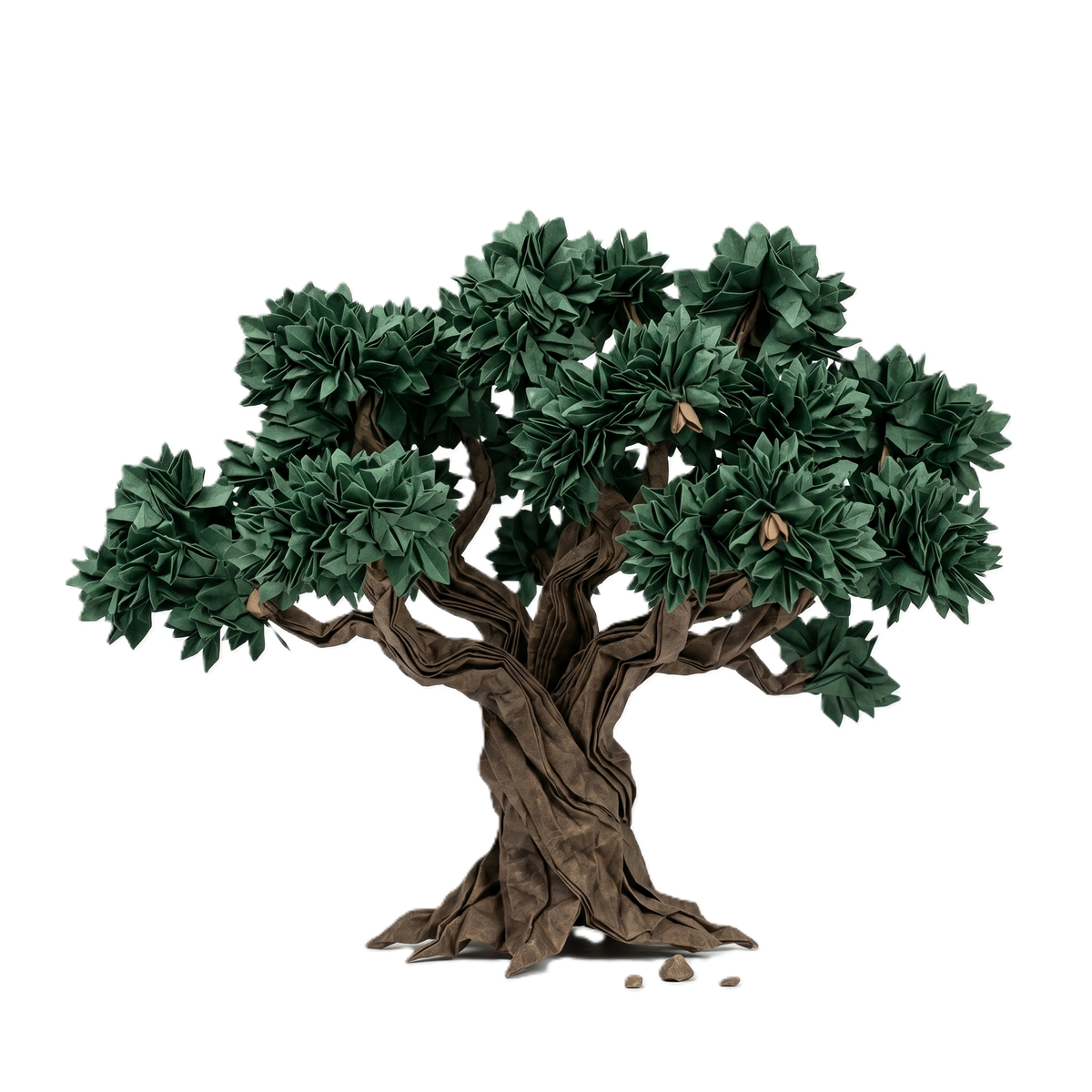
The African Iron Tree is the densest timber material in the world. Its wood sinks in water. Its grain blunts most saws. When carbonised — slowly, traditionally, in earth pits by craftsmen who have been doing this for generations — it produces a charcoal unlike anything else: ultra-fine, micro-porous, mineral-rich.
“The tree gave us iron in wood. We give it back to the skin as light.”

Why triple-roasted matters
A single firing carbonises the wood. A second refines the pore structure and burns off residual organics. The third — almost ceremonial in the source villages — opens the micro-pores fully and brings the surface area to its theoretical maximum. Each firing is judged not by clock but by smoke colour, the slow drift from grey to near-white that signals the carbon is ready.
The resulting charcoal is several orders of magnitude finer than anything you can buy commercially. Mass-produced charcoals undergo a single, rapid carbonisation in industrial kilns that prioritise yield. Ours go through a sequence — three pits, three fires, three rests — that prioritises pore structure. The difference shows up in the laboratory in surface area; on the skin, it shows up in the way the active draws impurities without stripping the lipid layer underneath.
It is also slow to produce, which is why we will never be a mass-market product. A batch enters the pit and three weeks later leaves it. Yield is low; waste is high. The work is dirty, hot, and patient, and the people who do it are paid by the day, not by the weight of what they produce. We pay for the patience because the patience is the product.
The third firing is the difference between an active that sits on the skin and one that does the work. We were asked once, at a trade show in Geneva, if we could skip it and still call the result Irontree. We said no. The third firing is not an option. It is the jar.
The fruit of the same tree
The African Iron Tree produces a small olive-shaped fruit, dark-skinned, rich in tannins and slow-release phenolic compounds. Traditionally used for skin protection and wound healing. In Irontree, the fruit essence is cold-pressed and added back to the carrier serum after the charcoal — pairing the binding action of the charcoal with the antioxidant signalling of the fruit. The two work together. Neither is as effective alone.

How we source it
Iron Tree charcoal is hand-prepared by a cooperative of charcoal-makers who have worked the same forest plots for three generations. The partnership is documented, the premium is fixed, and the families who do the work choose how that premium is distributed among themselves. We do not get a say in that distribution; we asked, once, and they preferred we did not.
We verify the harvest doesn’t exceed sustainable yield — the Iron Tree is slow-growing, and we will not be the brand that exhausts it. The cooperative replants on a multiple-for-one basis on plots they have managed since the 1980s, and the saplings planted then are coming into harvestable density now. There is enough Iron Tree, properly tended, to last us several generations. We intend to leave more behind than we found.
Every batch is traceable to its source pit. The pits are numbered, photographed, and logged at every firing; the charcoal that arrives in Aalen for blending carries a code that tells us which week it left the forest and which charcoal-maker tended the pit. If you ever ask us, we can tell you who carbonised the active in your specific jar.
What you hold in your hand when you uncap the dropper is, in a real sense, a hundred years of equatorial sunlight, compressed into a black liquid that disappears into the skin. It is also the work of named hands, three weeks of fire, and a partnership we are proud to have signed and intend to keep.